> For the complete documentation index, see [llms.txt](https://tempdocs.zerog.one/llms.txt). Markdown versions of documentation pages are available by appending `.md` to page URLs; this page is available as [Markdown](https://tempdocs.zerog.one/faq/mainsail/mainsail-theme-setup.md).
# Mainsail Theme Setup
Steps for setting up the mainsail theme for your user interface. Complete the installation with the provided instructions and enjoy the improved visual experience.
## Connect to SSH
{% stepper %}
{% step %}
### Launch your SSH client.
First, launch your SSH client, in my case it's [Putty](https://www.putty.org/).
 {% endstep %}
{% step %}
### Sign in
Then enter your Raspberry’s local IP address in the “Host” or “Server” field.
Follow the prompts to connect to your Raspberry. Note that your local IP address may differ from the one used in the example.
{% endstep %}
{% step %}
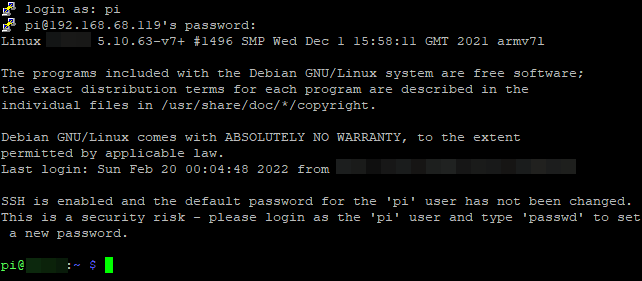
### Check your SSH Console
Your console should look similar to this.
 {% endstep %}
{% endstepper %}
### SSH Console & Commands
{% stepper %}
{% step %}
### Execute the following Commands
```bash
cd ~/
git clone https://github.com/ZeroGDesign/zerog-mainsail-theme.git
bash ~/zerog-mainsail-theme/install.sh
```
{% endstep %}
{% step %}
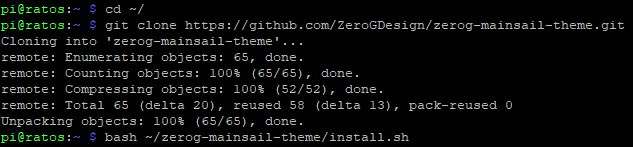
### Double check
If done correctly out would look somewhat like this
 {% hint style="warning" %}
The input field still shows a command we have to run, press **ENTER** on your keyboard to run the command.
{% endhint %}
{% endstep %}
{% step %}
### Ran the Code
Once executed, your console should display the message ‘*Theme has been installed, have fun!*’ indicating that this step is now complete.
 {% endstep %}
{% endstepper %}
## Dashboard
{% stepper %}
{% step %}
### Locate your Config Files
Locate the file ‘*moonraker.conf*’ and click on it.
 {% endstep %}
{% step %}
### Adding Them Update Script
Scroll down until you find the text *\[update\_manager]*.
*If you see an additional line that reads “enable\_auto\_refresh: True”, do not remove it. Simply proceed to the next line. Note that this line may not be present for all users.*
 {% endstep %}
{% step %}
### Insert Code
```yaml
[update_manager client ZeroGTheme]
type: git_repo
path: ~/zerog-mainsail-theme
origin: https://github.com/ZeroGDesign/zerog-mainsail-theme.git
install_script: install.sh
is_system_service: False
```
{% endstep %}
{% step %}
### Confirm Changes
Confirm your code looks somewhat similar to this.
 {% endstep %}
{% endstepper %}
## Final Steps
{% stepper %}
{% step %}
### Press Save & Restart
 {% endstep %}
{% step %}
### Restart Moonraker
If a notification appears asking you to **try again**, click on it to proceed.
 {% endstep %}
{% step %}
### Refresh your Browser
Refresh your browser to check if the ZeroG theme is now visible.
 ###
{% endstep %}
{% endstepper %}
### Update Manager
On the right-hand side, you will see the **Update Manager**. You should now notice that **ZeroGTheme** has been added. This will enable you to easily obtain the latest updates as they become available for the ZeroG Mainsail Theme.

### That's it, Enjoy!

---
# Agent Instructions
This documentation is published with GitBook. GitBook is the documentation platform designed so that both humans and AI agents can read, navigate, and reason over technical content effectively. Learn more at gitbook.com.
## Querying This Documentation
If you need additional information that is not directly available in this page, you can query the documentation by asking a question.
Perform an HTTP GET request on the following URL with the `ask` and `goal` query parameters:
```
GET https://tempdocs.zerog.one/faq/mainsail/mainsail-theme-setup.md?ask=&goal=
```
`ask` is the immediate question: it should be specific, self-contained, and written in natural language.
`goal` is what the user is ultimately trying to achieve, the reason they need the answer. Sharing it helps GitBook give you a better, more relevant answer. A goal is most helpful when it describes the outcome the user wants rather than restating the question. For example, with `ask=how do I create an API token`, a goal like `automate deployments from our CI pipeline` lets GitBook tailor the answer to that use case.
The response will contain a direct answer to the question and relevant excerpts and sources from the documentation.
Use this mechanism when the answer is not explicitly present in the current page, you need clarification or additional context, or you want to retrieve related documentation sections.